



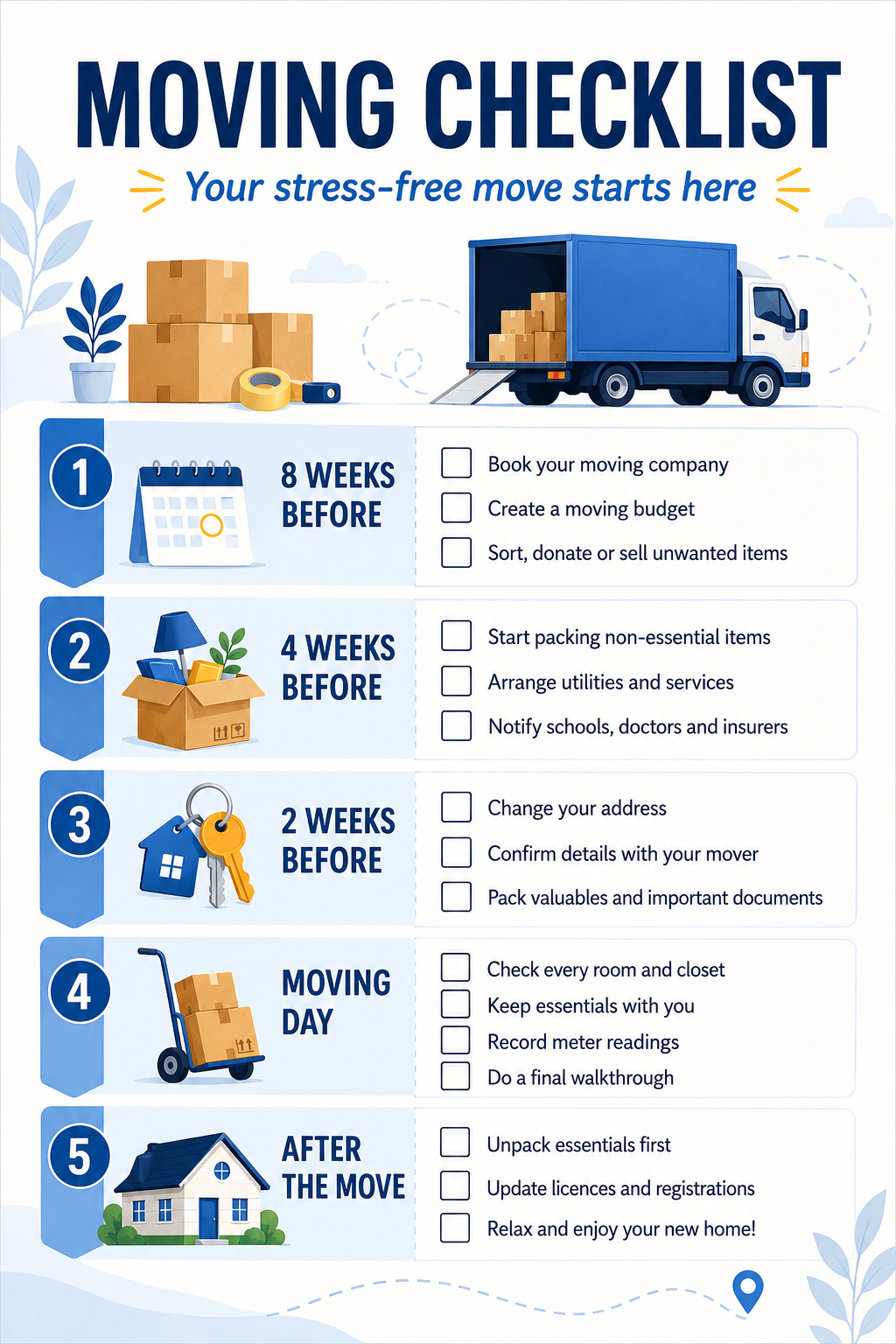
Key Takeaways
- Start your moving checklist 8 weeks before your move date for the smoothest experience, especially for a long distance move.
- The three things to do earliest: book your mover, start decluttering, and order packing supplies.
- Address changes have a specific order that matters: government accounts first (CRA, health card), then financial, then everything else.
- Pack an essentials bag for the last few days that travels with you, never on the truck.
- Provincial registrations (health card, driver’s licence, vehicle) have real deadlines after an interprovincial move, usually 30 to 90 days.
- Print this checklist or save it somewhere you will actually look at it during your move. A checklist only helps if you use it.
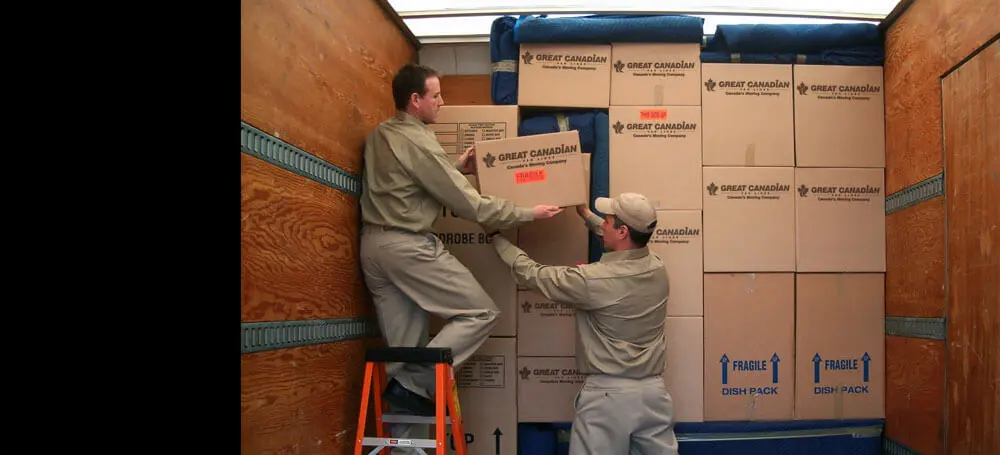
This is the checklist we wish everyone had in hand before their move. It is organized by how far out you are from moving day, so you can jump to wherever you currently are in the process. Print it, save it, or just scroll back to it as you go.
Want personalized help with your move? Get a free estimate from Great Canadian Van Lines and we will help you build a timeline specific to your situation.
8 Weeks Before Moving Day
| Decide on your move date and confirm it as firmly as possible |
| Research and get quotes from at least three moving companies |
| Verify your shortlisted movers are CAM members at movers.net |
| Book your mover once you have chosen |
| Start a folder (physical or digital) for all moving documents and receipts |
| Begin decluttering room by room, this is the best time to do it |
| If selling your home, consider basic staging steps now |
Choosing between movers? Read our guide to choosing a moving company which covers exactly what to check before you book.
6 Weeks Before Moving Day
| Order packing supplies: boxes in several sizes, tape, packing paper, bubble wrap, markers |
| Start packing storage areas, attic, basement, garage, and anything you rarely use |
| Research your new neighbourhood: schools, healthcare, grocery stores |
| If you have kids, start the school transfer process |
| Begin gathering medical, dental, and veterinary records to transfer |
| If renting, give formal notice to your landlord according to your lease terms |
4 Weeks Before Moving Day
| Set up Canada Post mail forwarding (do this at least 5 business days before your move) |
| Notify your employer of your upcoming move if relevant |
| Pack secondary rooms: guest bedroom, home office, dining room |
| Contact utility companies to schedule disconnection at your old home and connection at your new one |
| Confirm your moving date, services, and pricing in writing with your mover |
| Start using up frozen and perishable food rather than moving it |
Want a full packing schedule? Read our guide on how long it takes to pack for a move, with timelines broken down by home size and room.
2 Weeks Before Moving Day
| Pack the kitchen, except for one week of essentials |
| Pack living room items, books, decor, and wall art |
| Begin your address change list (see the order below) |
| Confirm childcare or pet care arrangements for moving day if needed |
| Arrange travel logistics if you are driving or flying to your new home |
| If moving long distance, confirm your delivery window with your mover |
Address change order that actually makes sense
- 1. Canada Revenue Agency, critical for taxes and benefit payments
- 2. Your bank and any other financial institutions
- 3. Service Canada, for CPP, OAS, or EI if applicable
- 4. Your employer and payroll
- 5. Insurance policies (home, auto, life, health)
- 6. Subscriptions and regular billing
- 7. Voter registration with Elections Canada
- 8. Everything else: loyalty programs, professional associations, and so on
1 Week Before Moving Day
| Pack most of the master bedroom, leaving a few days of clothing accessible |
| Finish packing bathrooms except daily essentials |
| Confirm all details with your mover one more time: date, time, address, contact number |
| Pack your essentials bag (see below) |
| Set aside documents, medications, jewellery, and anything irreplaceable to travel with you |
| Charge all electronics and back up anything important |
What goes in your essentials bag
- Phone charger and any other chargers you need daily
- A few days of clothing and toiletries
- Medications
- Important documents (passports, ID, moving contract)
- Snacks and water
- Basic tools for assembling furniture
- Phone numbers for your mover, landlord or realtor, and utility companies
Moving Day
| Do a final walkthrough of every room, closet, and storage space before the truck leaves |
| Be present for loading if possible, and for the weigh-in if your move is weight based |
| Take photos of your empty old home for your records |
| Keep your essentials bag, valuables, and documents with you, not on the truck |
| Leave keys, garage remotes, and any documentation behind for the new owners or landlord if applicable |
| Confirm your delivery window one last time before the truck departs |
After You Arrive
| Inspect items before signing the delivery receipt, and note any damage in writing before you sign |
| Set up the essentials first: bed, bathroom, kitchen basics |
| If you moved provinces, apply for your new health card right away (there is often a waiting period) |
| Register your vehicle and get a new driver’s licence within your new province’s deadline (usually 30 to 90 days) |
| Locate the essentials nearby: pharmacy, walk-in clinic, grocery store |
| Start exploring your new neighbourhood on foot when you get a chance |
Just arrived and figuring out the city? Read our guide on how to settle into a new home and neighbourhood which covers a realistic timeline for feeling at home and practical tips for getting oriented.
Frequently Asked Questions
How far in advance should I start my moving checklist?
Eight weeks before your move date is a good starting point for most moves, and gives you enough time to book a mover, declutter properly, and avoid a rushed final stretch. For a larger home or a long distance move, ten to twelve weeks is even better.
What is the most important thing to do first?
Book your mover as early as possible once you have a confirmed date. Good movers and good dates get reserved weeks in advance, especially during the busy summer season.
What should never go on the moving truck?
Important documents, medications, jewellery, cash, and anything irreplaceable should always travel with you personally, not in the moving truck.
How do I know if my checklist is missing something specific to my move?
This checklist covers the essentials for most household moves. If you have pets, are selling a home, or are moving cross border to the US, those situations involve additional steps. Check our dedicated guides for those specific situations.
Ready to check off the first item on this list? Get a free moving estimate from Great Canadian Van Lines and let us help you build a timeline that works for your move.
